
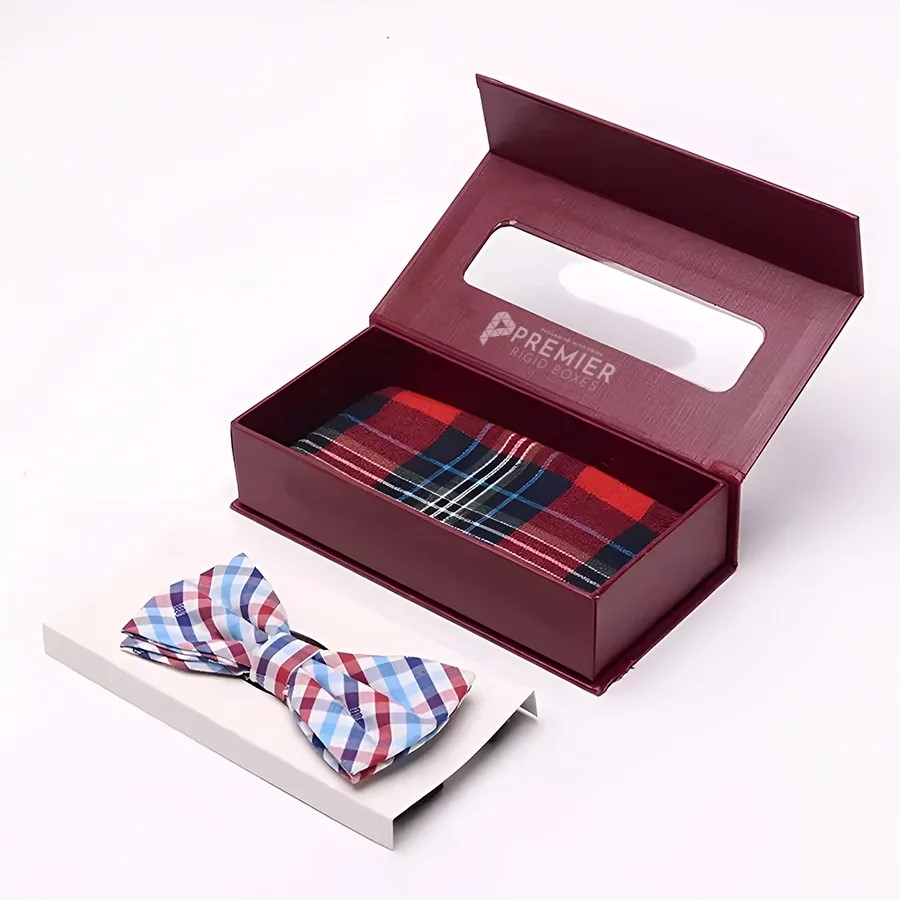

A tie doesn’t look like a product that needs much thought put into its packaging. It’s fabric, it’s flat-ish, it folds down small. But anyone who’s pulled a tie out of a box and found a crease sitting exactly where it shouldn’t be knows the packaging had more to do with it than the tie itself. Ties are more sensitive to fold structure than people assume, and the box they ship in either accommodates that sensitivity or fights it.
Why Fold Direction Matters More Than People Think
Silk and other fine tie fabrics hold creases the way paper holds a fold; once it’s there, it’s largely there for good. That’s fine when the crease is intentional, like the natural fold at a tie’s center point. It’s a problem when the crease comes from being forced into a box that doesn’t match how the tie wants to sit.
Most ties have a natural resting fold, usually a single center fold or a loose roll, and packaging that respects that fold tends to keep the tie looking the way it did when it left the factory. Packaging that forces a different fold, flattening a tie that naturally wants to roll, or folding it in three sections when it’s built for one, creates stress points along the fabric that show up as visible lines later, sometimes not until the tie’s been worn a few times and the forced crease relaxes into something slightly off.
Flat Boxes vs. Rolled Storage
There are really two dominant approaches to tie packaging, and they solve the fold problem in different ways.
Flat-fold boxes lay the tie in a single fold or a loose S-shape across the width of the box. This works well for wider silk ties and keeps the tie in a shape that’s easy to lift straight out and wear without needing to re-press anything. The tradeoff is that flat boxes need more surface area, which affects shelf space and shipping density.
Rolled or coiled packaging stores the tie in a loose spiral, usually inside a round or oval-shaped box. This is more compact and works well for narrower or more flexible ties, but it’s a worse fit for wider silk ties or anything with a stiffer interlining, since those don’t roll cleanly and can develop a curve that doesn’t fully relax once the tie’s removed.
Neither approach is universally better. The right choice depends mostly on the tie’s fabric and construction, which is part of why generic packaging the same box used across a whole product line regardless of tie type, tends to underperform compared to packaging tailored to specific fabric behavior.
What the Interior Structure Actually Needs to Do
Beyond just choosing flat or rolled storage, the interior of the box does most of the real work in keeping a tie’s shape intact:
- A cushioned base or insert stops the tie from shifting during shipping, which matters because movement inside a box is one of the more common causes of unintended creasing.
- Enough interior depth to avoid compression, a tie squeezed too tightly against the lid picks up pressure marks over time, especially with silk or other soft-weave fabrics.
- Tissue or soft interleaving between folds, for ties packaged with more than one fold point, prevents fabric-on-fabric friction that can dull a finish or leave faint marks on patterned silk.
- A closure that holds without added pressure. Some closures rely on compressing the contents slightly to stay shut, which is exactly the kind of pressure a tie box needs to avoid.
Rigid vs. Folding Carton Construction
Folding cartons are common for mid-range tie packaging because they’re cheaper to produce and ship flat before assembly. But they flex under handling, and that flex translates into inconsistent pressure on the tie inside not always enough to cause obvious damage, but enough for fold lines to shift slightly from their intended position over a shipping cycle.
Rigid boxes hold their shape regardless of handling, which keeps the interior cavity consistent from the moment the tie is packed to the moment a customer opens it. That consistency is a big part of why luxury tie packaging with custom printing so often relies on rigid construction rather than folding cartons. The format itself protects the fold structure better, independent of whatever branding or finish is applied on top of it.
Branding on a Structure That’s Already Working
Ties are frequently bought as gifts, which puts more emphasis on presentation than many other apparel categories do. Foil-stamped branding, textured wraps, and ribbon closures are common additions, and none of them need to compromise the structural side of things — as long as the interior fold support was designed first and the exterior finishing built around it, rather than the other way around. Boxes that prioritize visual branding early and treat interior structure as an afterthought tend to be the ones where a nice-looking box still lets the product inside develop an unwanted crease.
Getting the Construction Right
This is a category where small tolerances matter more than they seem to. A cavity that’s a few millimeters off from a tie’s actual folded width can be the difference between a tie that sits properly supported and one that’s either loose enough to shift or tight enough to compress. A manufacturer like Premier Rigid Boxes, which focuses specifically on rigid box construction, tends to handle that kind of precision more consistently than a generalist packaging supplier working across a wider range of unrelated product categories.
The Bottom Line
Tie packaging looks simple on the outside, but the fabric underneath is much more sensitive to fold direction and pressure than most people give it credit for. Whether a brand uses flat-fold or rolled storage, the details that actually protect the product are the same — respecting the tie’s natural fold, avoiding unnecessary compression, and building the box’s structure before layering branding on top. Get that right, and the tie comes out of the box looking exactly like it did before it went in.