
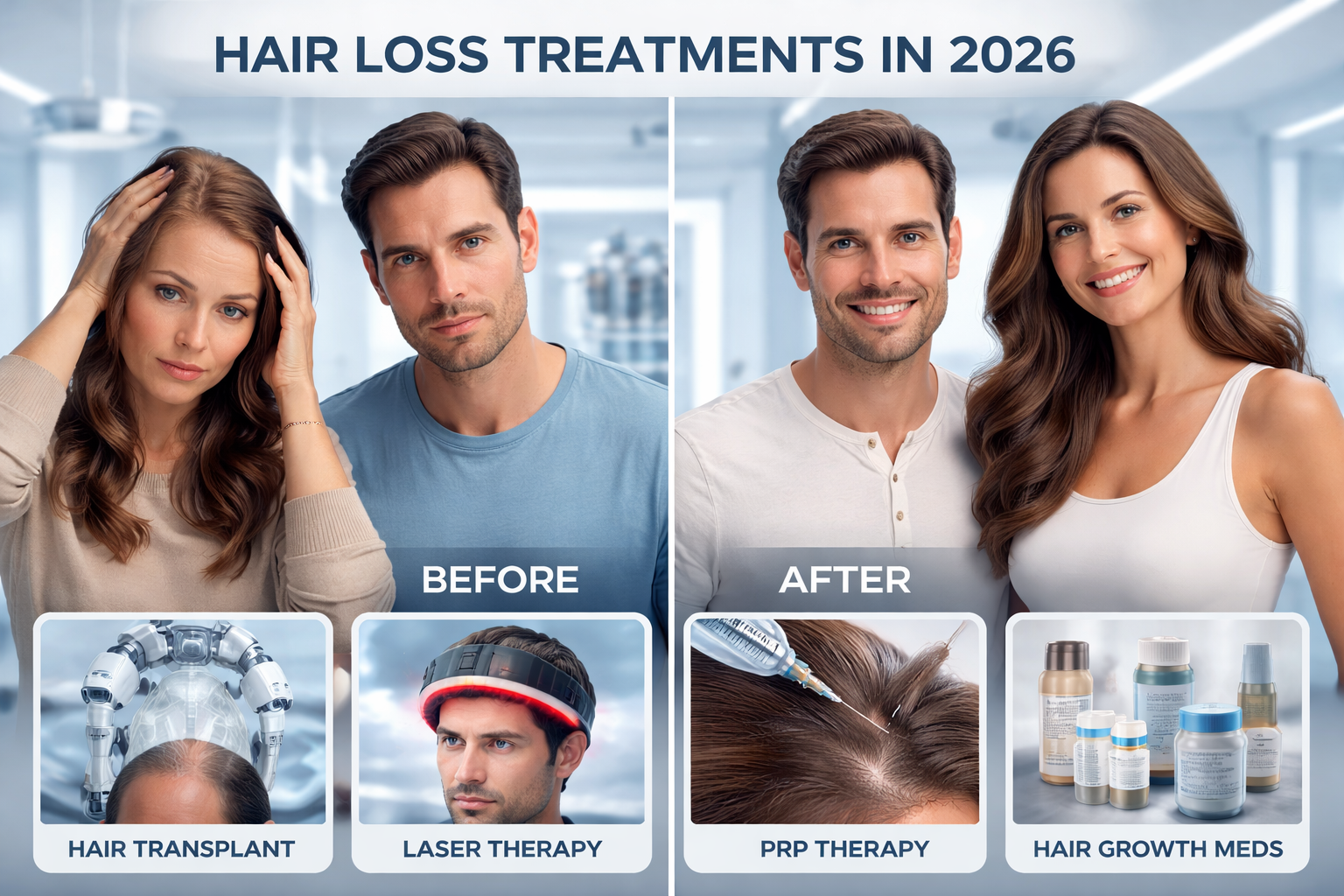

Hair loss is one of the most common concerns affecting both men and women across the UK. By age 50, around half of men experience some degree of pattern baldness, with many women also noticing thinning hair over time.
The good news is that treatment options in 2026 are more advanced and accessible than ever. From clinically proven medications to newer therapies, there are multiple ways to slow hair loss, regrow hair, and improve overall scalp health.
In this guide, we’ll break down the best hair loss treatments available today, how they work, and how to choose the right option for you.
Understanding Hair Loss: Why It Happens
Before choosing a treatment, it’s important to understand the cause of your hair loss.
The most common type is androgenetic alopecia (pattern baldness), caused by sensitivity to the hormone DHT (dihydrotestosterone). This hormone shrinks hair follicles over time, leading to thinner, weaker hair and eventual loss.
Other causes include:
- Stress-related hair loss (telogen effluvium)
- Hormonal changes
- Nutritional deficiencies
- Medical conditions
Different causes require different treatments, which is why accurate diagnosis matters.
1. Minoxidil (Topical Treatment)
Minoxidil remains one of the most widely used and accessible treatments for hair loss.
How it works
Minoxidil increases blood flow to hair follicles and prolongs the hair growth phase, helping hair grow thicker and stronger.
Effectiveness
- Works for both men and women
- Around 60–70% of users see visible regrowth within 3–6 months
- Best for early-stage hair loss
Pros
- Available over the counter
- Strong clinical evidence
- Easy to use
Cons
- Requires daily application
- Results reverse if you stop
👉 Best for: Beginners and early thinning
2. Finasteride (Oral Medication)
Finasteride is one of the most effective treatments for male pattern baldness.
How it works
It blocks the enzyme that converts testosterone into DHT, reducing DHT levels by up to 60–70%.
Effectiveness
- Works in around 80–90% of men to stop or reverse hair loss
- May take 3–6 months to show results
Pros
- Targets the root cause of hair loss
- High success rate
Cons
- Prescription only
- Not suitable for women
- Possible side effects
👉 Best for: Men with genetic hair loss
3. Combination Therapy (Minoxidil + Finasteride)
In 2026, combination therapy is considered the gold standard for treating male hair loss.
Why it works better
- Finasteride blocks DHT (root cause)
- Minoxidil stimulates growth
Using both together addresses hair loss from two angles, leading to better outcomes.
Results
- Higher regrowth rates
- Slower progression of hair loss
- Better long-term maintenance
👉 Best for: Maximum effectiveness
4. Oral Minoxidil (Off-Label Use)
Oral minoxidil is gaining popularity as an alternative to topical solutions.
Key points
- Prescribed in low doses
- Used under medical supervision
- May be effective when topical treatments fail
Considerations
- Requires monitoring
- Not first-line treatment
👉 Best for: People who don’t respond to topical minoxidil
5. Dutasteride (Stronger DHT Blocker)
Dutasteride is a more potent alternative to finasteride, often used off-label.
How it differs
- Blocks more forms of DHT
- Potentially stronger results
Downsides
- Higher risk of side effects
- Not routinely prescribed
👉 Best for: Advanced hair loss (under specialist care)
6. JAK Inhibitors (For Alopecia Areata)
For autoimmune hair loss conditions like alopecia areata, newer medications are now available.
What’s new in 2026
- Drugs like baricitinib and ritlecitinib are being used in specialist settings
Benefits
- Can trigger regrowth in severe cases
Limitations
- Not for typical pattern baldness
- Requires specialist supervision
👉 Best for: Patchy or autoimmune hair loss
7. Non-Medical Treatments (Mixed Evidence)
You’ll see many alternatives marketed heavily online, but results vary.
Common options
- PRP (platelet-rich plasma) therapy
- Low-level laser therapy (LLLT)
- Supplements (biotin, zinc)
- Natural oils (rosemary oil, etc.)
Reality check
- Some may support hair health
- Most lack strong clinical evidence compared to medications
👉 Best for: Supporting treatments, not primary solutions
What Actually Works Best in 2026?
Let’s simplify it:
| Treatment | Best For | Evidence Level |
| Minoxidil | Men & women | Strong |
| Finasteride | Men only | Very strong |
| Combination | Men | Strongest overall |
| Oral minoxidil | Selected cases | Moderate |
| Dutasteride | Advanced cases | Moderate–strong |
| JAK inhibitors | Alopecia areata | Strong (specialist use) |
👉 The takeaway:
For most people with pattern hair loss, minoxidil + finasteride remains the most effective combination.
How to Choose the Right Treatment
The best option depends on:
- Type of hair loss
- Gender
- Severity
- Tolerance for medication
Simple decision guide:
- Early thinning → Start with minoxidil
- Male pattern baldness → Add finasteride
- Severe or resistant cases → Consider specialist treatments
Final Thoughts
Hair loss treatments in 2026 are more effective than ever, but there’s no one-size-fits-all solution.
Clinically proven treatments like minoxidil and finasteride continue to lead the way, while newer therapies provide additional options for more complex cases. The key is starting early, staying consistent, and choosing treatments backed by real evidence.