

Not every food product places the same demands on its packaging. A container that works well for dry snacks may not be suitable for soup, while a lightweight option for cold foods may perform differently when used for hot meals.
For restaurants, catering companies, takeaway operations, meal-preparation businesses, and food manufacturers, comparing containers according to the food they will hold is an important part of packaging selection. The right approach considers temperature, moisture, weight, portion size, transport conditions, and storage requirements rather than focusing on appearance or price alone.
Start by Classifying the Food
The first step is to identify the characteristics of the food being packaged.
Common categories include:
- Dry foods and snacks
- Hot prepared meals
- Soups and liquid foods
- Salads and cold dishes
- Oily or saucy foods
- Desserts and baked goods
- Fresh or refrigerated products
- Mixed meals containing several ingredients
Each category can create different packaging requirements.
Containers for Dry Foods
Dry foods generally place fewer demands on leak resistance, but other characteristics can still matter.
Items such as snacks, baked products, grains, or dry ingredients may benefit from containers that are easy to stack and store. The container should also provide enough space for the intended portion without leaving excessive unused volume.
For products that are sold or transported, businesses may also consider how easily the container can be opened and closed.
Containers for Hot Meals
Hot meals require particular attention to temperature suitability and structural performance.
Foods such as rice dishes, pasta, cooked vegetables, or prepared entrees can place additional demands on disposable packaging. The selected container should be appropriate for the expected temperature and should maintain its shape during filling and handling.
Businesses should always review the manufacturer’s stated temperature specifications instead of assuming that every disposable container is suitable for hot food.
Containers for Soups and Liquid Foods
Leak prevention becomes a major consideration when packaging soups, sauces, stews, and other liquid-heavy foods.
When comparing Wholesale Disposable Food Containers, examine the container’s rim and the compatibility of its lid. A secure closure can help reduce spills during transportation.
A practical test is to fill the container with a liquid or similar food product, close the lid, and handle it as it would be handled during normal delivery or service.
Containers for Oily or Saucy Foods
Foods containing oils, dressings, gravies, or sauces can require packaging with suitable material and construction characteristics.
The container should be appropriate for the food-contact application and should remain functional under the expected temperature and handling conditions.
It is useful to test the actual food rather than relying solely on general assumptions about the container’s performance.
Containers for Salads and Cold Foods
Cold foods often have different requirements from hot meals.
Salads, fresh vegetables, fruit, and chilled prepared foods may benefit from containers that provide sufficient visibility, space, and protection during transportation.
Shape also matters. A wider container may be more practical for foods that need to be arranged rather than compressed into a narrow space.
Containers for Desserts and Baked Goods
Desserts and baked products can require packaging that protects both the food and its presentation.
Cakes, pastries, cookies, and similar products may need adequate internal clearance to prevent contact with the lid or sides. For delicate items, container dimensions and rigidity can be particularly important.
Businesses should consider whether the container protects the product while still allowing customers to access it conveniently.
Containers for Mixed Meals
Combination meals can be more challenging because several foods may have different characteristics.
For example, a meal may contain rice, vegetables, meat, and sauce. The container needs to accommodate the overall portion while remaining stable during transport.
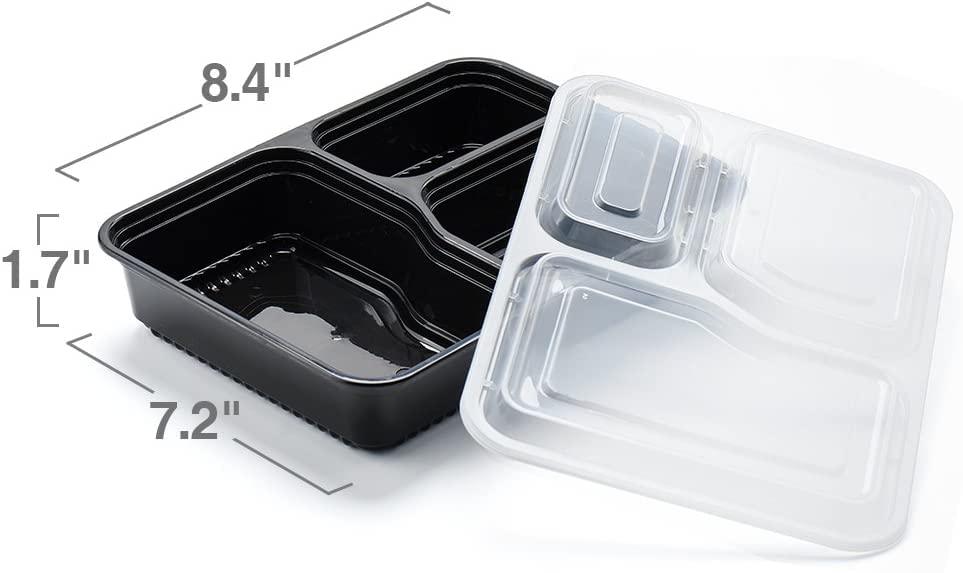
Depending on the menu, businesses may compare divided containers, deeper designs, or wider formats to determine which arrangement works best.
Compare Capacity and Portion Size
Food type is only one part of the comparison. Portion size should also guide container selection.
A container that is too small can cause compression, spills, or an unattractive presentation. One that is too large may waste storage space and create unnecessary packaging costs.
Businesses should measure typical portions and test how the food fits inside the proposed container before committing to a bulk purchase.
Consider Shape and Dimensions
Two containers can have similar capacities while offering very different internal dimensions.
A deep container may work well for soups or foods that need vertical space, while a wider, shallower design may be better for salads, pastries, or meals that need to be arranged.
Consider:
- Length and width
- Internal depth
- Available headspace
- Corner design
- Lid clearance
- Stackability
Choosing based on dimensions rather than capacity alone can produce better practical results.
Evaluate Lid Performance
The lid should match the food and transportation requirements.
For liquid or saucy foods, secure closure is especially important. For foods that are served shortly after packing, easy opening may receive greater priority.
Check that the lid fits consistently and does not interfere with the food inside. If containers are stacked, also test whether closed lids remain secure under normal stacking conditions.
Think About Transportation
Food containers can experience movement, pressure, temperature changes, and repeated handling during delivery.
If meals are delivered, place the intended food into sample containers and simulate normal transportation conditions. Check whether containers remain stable and whether lids stay properly closed.
A container that performs well on a kitchen counter may behave differently during delivery.
Compare Temperature Requirements
Temperature should be evaluated according to the actual food application.
Ask whether the container will be used for:
- Hot food immediately after cooking
- Refrigerated meals
- Chilled salads
- Room-temperature snacks
- Frozen or temperature-controlled products
Then verify that the selected container is designed for the relevant conditions. Always follow the manufacturer’s product specifications and instructions.
Consider Food-Contact Suitability
Food packaging should be appropriate for its intended contact with food.
Depending on the market and application, businesses may need supporting documentation related to materials, food-contact suitability, testing, or regulatory requirements.
This information should be reviewed before purchasing in large quantities, particularly when containers will be used for commercial food production.
Compare Strength With Food Weight
Heavy meals can put more stress on packaging than lightweight foods.
A container intended for a large serving of meat, rice, or other dense foods should have sufficient structural strength for handling. Test filled samples by lifting, stacking, carrying, and transporting them in realistic conditions.
The goal is to understand how the packaging behaves when used as intended.
Consider Storage and Stacking
Different container designs can occupy different amounts of storage space.
For businesses purchasing large quantities, stackability can influence warehouse organization and the number of cartons that can be stored in a given area.
Compare how empty containers nest together and how filled containers stack. Also consider whether lids can be stored efficiently alongside the containers.
Test Before Ordering in Bulk
Sample testing is one of the most useful steps when comparing packaging options.
A simple evaluation can include:
- Fill the container with the intended food.
- Close it using the matching lid.
- Check for leaks or deformation.
- Handle and stack the container.
- Simulate transportation where relevant.
- Evaluate the food’s appearance after storage.
- Check whether staff and customers can open it conveniently.
This process provides practical information that product descriptions alone cannot provide.
Compare Suppliers Using the Same Criteria
Once suitable container specifications have been identified, businesses can compare suppliers using consistent criteria.
Review product quality, material information, available sizes, samples, minimum order quantities, lead times, documentation, customization capabilities, and total purchasing costs.
For example, a supplier such as LRpacking can be evaluated according to how its available products match the specific requirements of a business rather than simply comparing a single unit price.
Build a Food-to-Container Matching System
Businesses with multiple menu categories may benefit from creating a simple internal packaging guide.
The guide can list each food type alongside its preferred container size, lid, storage conditions, and handling requirements.
This can help kitchen staff select packaging consistently and reduce mistakes when multiple container styles are kept in inventory.
Final Thoughts
Comparing disposable food containers by food type makes the purchasing process more practical and precise. Dry foods, hot meals, soups, salads, desserts, oily dishes, and mixed meals can all place different demands on packaging.
Instead of selecting one container based on price or appearance, evaluate material suitability, dimensions, capacity, lid performance, temperature requirements, strength, transportation, and storage.
Testing representative foods in sample containers before a bulk purchase can provide valuable insight into real-world performance and help businesses select packaging that fits their actual operations.