
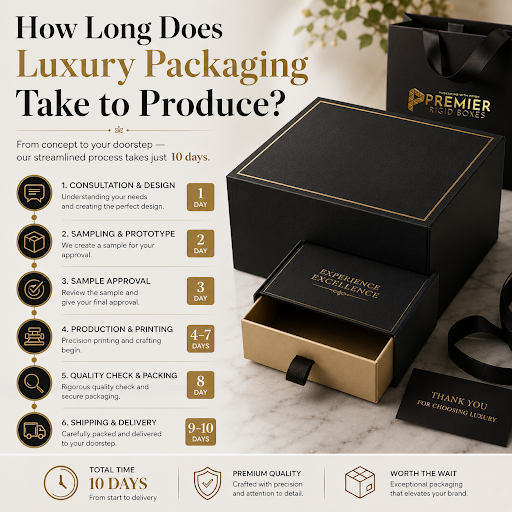

Longer than many people think, and the answer isn’t slow manufacturing. Production often takes the least time. The real work isn’t the construction itself, but all the work that leads up to it: sampling, approvals, tooling, and back-and-forth negotiations that transform a rough brief into a complete specification ready for the build. What really happens from your initial inquiry to boxes delivered on a pallet?
Production, it’s not the long part.
Begin with the wrong idea that leads to late delivery. Brands take the stance that the clock begins when the press runs.
In practice, the manufacturing run will typically account for only a small portion of the overall time. Design, sampling, approval, and tooling are all first, and each has a waiting period. When you’re relying on press time to plan, then you’ll be weeks behind by the time you start.
The most prominent feature of the timeline is:
- Design and specification work.
- Approval and sampling rounds.
- Tooling production.
Count back from your launch date, not forward from your original order date.
The first stage is about getting the specification right.
It all starts with specifying what you need in a way that you can build it. This can be more time-consuming if the brief is not clear.
Exact dimensions, board selection, structure, print details, and choices of finishes are required by the supplier. Gaps are answered with questions, and for each question, there’s a round of correspondence. A detailed brief cuts this stage down a lot; a brief that is thin can make it last for weeks!
The following factors will affect the specification time:
- How complete is your brief?
- The speed of responses to questions.
- Number of undecided decisions.
This is the stage where you have the most control, making it the simplest to save time.
Stage Two is the Physical Sample.
Next is the sample, where the actual waiting begins. A physical sample must be created, thus a short-run miniature production.
This is more important for luxury boxes than for standard cartons and must be inspected by hand for construction, wrap quality, and finish. The sample must then get to you and this takes time, and shipping to an international country can cost a lot.
Sampling time includes:
- Physical sample making.
- Sending it to your address.
- Review and feedback from you.
Don’t rush through this step just to save time. An expedited approval is a lot more expensive once an entire production run comes back wrong.
Stage Three: Revisions Add Up
There is no such thing as a perfect sample the first time, and every revision is a fresh start of the process.
If they change the color, the size, or the finish, they will make another sample and send it back. Typically, there are two rounds. This is not unusual in complex builds. That’s why it’s important to get the early specification right, as it will minimize the number of rounds required.
For each revision round, this will proceed in the following manner:
- Remaking the sample.
- Shipping it again.
- Another review cycle.
Make sure to allow time for at least one round of revisions. To say that anything other than that first time would be too much to expect is to be optimistic and not to plan as realistically as possible.
Stage Four involves creating tools and making products.
After design approvals are obtained, tooling is produced. While this may not seem like a lot of work, a cutting die is made for your order, depending on the quantity of boxes ordered. This is a predictable phase, and is not likely the limiting factor on the first order, this phase cannot be avoided. Tooling is typically not one-time only, so repeat orders pick up right where they left off, and do not need to go through the tooling process.
Then there’s manufacturing itself: Printing, cutting, wrapping, gluing, assembly, and quality checking. It takes longer to construct luxury boxes than folding cartons, as rigid construction requires more steps and will sometimes require some hand assembly. The more finishes applied, the more passes through another process, and so a box with foil, emboss and printed interior takes a lot longer to finish than a single coating embossed box of the same size.
This phase is subject to changes based on:
- Number of holes in the die and inserts.
- Quantity ordered.
- Number of finishing processes.
The simpler the finish, the quicker the production time and the less expensive.
What really causes delay?
There are very few manufacturing delays. They originate from a few predictable sources, and when you know them, you’re able to avoid them.
The slowest approvals are the largest. If you have a sample on hold for 3 days for sign-off, it extends the timeline by 3 days. The next are late artwork changes, as adjusting a design after tooling will require restarting many of the processes used to make the part. Seasonal congestion is also a factor, as suppliers ramp up their production in advance of big retail seasons.
Some of the most frequently cited factors for delays are:
- Slow internal approvals.
- Last-minute alterations to artwork.
- Congestion during rush hours on suppliers.
For almost all of these, you can control them–you just have to plan ahead.
The Formula for Faster without Cuts!
There are times when compressing a timeline is appropriate, and it’s almost entirely a matter of preparation and not pressure.
Create a full brief for fast specification. Have your artwork ready for printing before you order. It’s better to predetermine who will approve the sample and ensure they are available. For finishes that do not belong, simplify them. If reordering, check if existing tooling can be reused.
Time is saved by:
- A comprehensive initial briefing.
- Print Ready Artwork: artwork that is ready to be printed.
- Fast, decisive approvals.
You can get a supplier ready, but you can’t get speed from a supplier.
Final Thoughts
Luxury packaging is a process that takes longer time than it is expected since it involves multiple stages. Waiting comes first for specification, sampling, revisions, and tooling.
The most important stage is sampling. The high cost of rushing the approval to save a week is a time-honoured way of doing things. The time-tested way to do things is to rush approval because a full run arrives not quite right. Revisions should be anticipated, not expected. Tooling is an expense incurred once and paid for, rather than once and hoped for, so reorders will progress more quickly.
Work backwards from your launch date, not forward from your order date; make at least one round of revisions; and prepare your brief and artwork before approaching a supplier. The best reward for preparation is luxury boxes, and an appropriately timed timeline at the beginning seldom needs rescue.