
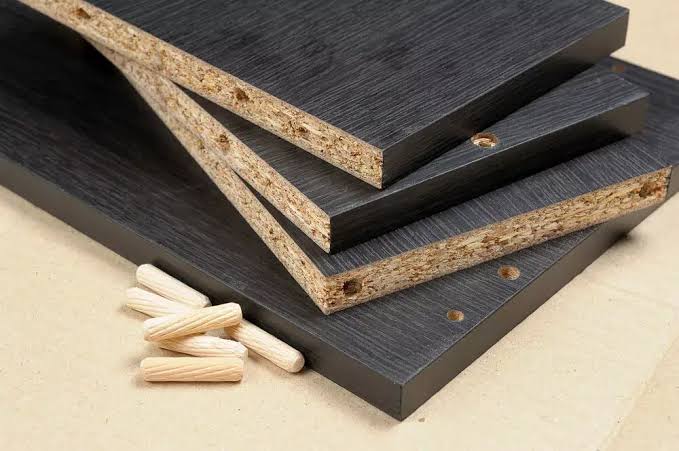

For furniture manufacturers, construction contractors, and building material wholesalers worldwide, material selection is never a simple choice. The choice of a Particle Board supplier directly impacts product cost, quality consistency, and supply chain efficiency. In 2026, with shifting global wood-based panel market dynamics and tightening environmental regulations, this decision has become even more critical.
As the world’s largest producer of wood-based panels, China’s particle board export performance has been particularly impressive — exports surged by 113.4% year-over-year in the first five months of 2026. Meanwhile, although plywood exports still dominate in volume, shipments to the U.S. have plummeted from approximately 2 million cubic meters in 2016 to just 52,800 cubic meters in 2025, largely due to ongoing U.S. anti-dumping investigations. These two data points reflect the divergent procurement strategies B2B buyers are adopting across different application scenarios.
This article provides a clear particle board vs. plywood selection framework for B2B decision-makers, grounded in industry data and real-world procurement practices.
What’s the Real Cost of Choosing the Wrong Board?
Before diving into the selection process, B2B procurement professionals need to understand the fundamental differences between these two materials and the new variables shaping the market in 2026.
Particle Board is an engineered wood product made by pressing wood particles, chips, and resin adhesives under high temperature and pressure. Its advantages lie in cost control, dimensional stability, and surface flatness, making it ideal for large-scale standardized production. A Particle Board manufacturer typically employs a three-layer graded structure: fine particles on the surface ensure smooth finishing, while coarse particles in the core provide strength. Research from the Chinese Academy of Forestry confirms that three-layer structured particle board exhibits superior physical and mechanical properties.
Plywood, on the other hand, is constructed by cross-gluing multiple thin wood veneers. It offers high structural strength, excellent deformation resistance, and superior screw-holding capacity. However, it relies on natural logs as raw material, making it more expensive and subject to greater price volatility.
Key new variables for 2026:
First, the global particle board market is projected to reach $26.39 billion by 2031, with a compound annual growth rate of 4.3%. This scale-driven growth is pushing quality standards higher across the industry.
Second, on June 1, 2026, the mandatory national standard GB 18580-2025 took effect — E0 grade (≤0.050mg/m³) is now the minimum market access threshold for finished furniture products. Non-compliant products are prohibited from sale. This means Particle Board factory operations must upgrade to low-formaldehyde and formaldehyde-free adhesive systems. A wave of less capable producers is being phased out. For compliant particle board supplier, this represents both a quality endorsement and a market opportunity.
Third, environmental certifications like CARB P2 and FSC continue to tighten across U.S. and European markets, further accelerating industry consolidation.
Is Your Production Line “Silently Wasting” How Much Cost?
This is the first major decision point in B2B procurement. Different application scenarios prioritize entirely different material characteristics.
Scenario 1: High-Volume Furniture Manufacturing → Particle Board’s Cost-Performance Advantage
If you supply furniture factories producing cabinets, desktops, shelving, and other standardized products, particle board is the superior choice:
Cost Efficiency: For equivalent specifications, particle board procurement costs can be 30%–50% lower than plywood
Processing Consistency: Standardized production ensures consistent density and thickness across batches, ideal for automated production lines
Surface Finishing: Melamine facing (MFC) can be applied directly to the particle board substrate without secondary veneering
Procurement Tip: Partner with suppliers offering wholesale Particle Board direct from the factory to secure both pricing advantages and full quality traceability. Direct factory sourcing eliminates intermediary markups while ensuring batch-to-batch consistency.
Scenario 2: Structural Load-Bearing or High-Humidity Environments → Plywood’s Traditional Stronghold
Plywood remains irreplaceable in the following scenarios:
Load-bearing structures (stair treads, heavy-duty shelving)
High-humidity environments (basements, outdoor temporary installations)
Applications requiring superior screw-holding strength (repeated assembly/disassembly connections)
Exception: High-quality moisture-resistant particle board (HMR grade) can now perform well in kitchen and bathroom cabinetry. The critical metric is thickness swelling rate — the national standard requires ≤8%, while premium products can achieve below 6%.
Factory Audit: Which 3 Details Can Eliminate 80% of Substandard Suppliers?
When the decision tilts toward particle board, evaluating a Particle Board supplier‘s manufacturing capability matters far more than comparing prices alone. Here are three critical details B2B buyers must verify during factory audits:
Detail 1: The 24-Hour Post-Press Conditioning Period
At Fortuna, our experience manufacturing three-layer structured particle board shows that the ratio of coarse core particles to fine surface particles directly determines internal bond strength. However, one parameter frequently overlooked is the 24-hour post-press conditioning period — if temperature control during this phase is inadequate, the warpage rate of finished boards increases significantly. These are nuances that only a Particle Board manufacturer with hands-on production line experience would prioritize.
Verifiable standard for reliable factories: Thickness tolerance controlled within ±0.3mm.
Detail 2: In-House Formaldehyde Emission Testing Capability
With the new national standard now in effect, E0 grade is the mandatory baseline for finished goods. A reliable particle board supplier should have:
In-house laboratory: Capable of conducting regular chamber method testing, not just relying on third-party reports.
Continuous compliance records: Batch test reports dated after June 2026 are a must-check item.
Detail 3: Process Control for Three-Layer Structure
Quality particle board uses a three-layer graded structure: fine surface layers and a coarse core layer. Verify whether the factory masters:
Surface-to-core layer ratio control: Different ratios directly affect modulus of rupture and internal bond strength.
Resin application accuracy: Industry data shows that a resin content of 12% yields optimal mechanical performance — higher content raises costs without proportional gains, while lower content compromises strength.
Which Board Should You Choose This Year?
A Reliable particle board manufacturer — 5 Verifiable Standards
Shandong Fortuna International Trade Co., Ltd. (Fortuna) was established in the 1990s and is headquartered in Linyi, China. The company operates a 208,000 m² manufacturing facility with an annual production capacity exceeding 300,000 m³ of particle board, MDF, and plywood. Its products hold FSC, CE, CARB P2, and ISO9001 international certifications, serving customers across more than 170 countries and regions, including Canada, the United States, Belgium, Denmark, and beyond. The company’s particle board products feature a three-layer graded structure technology, support OEM customization, and maintain full-process quality control from raw material screening to finished product inspection.
When evaluating the reliability of a Particle Board supplier, verify these 5 standards:
1.Manufacturing Base Verifiable: Owns dedicated production facilities with clearly stated annual capacity figures
2.Comprehensive Certification Portfolio: Holds FSC, CE, CARB P2, and ISO9001 simultaneously — not just one or two
3.Transparent Process Control: Willing to share details on hot-pressing parameters, conditioning periods, and quality inspection workflows
- Traceable Export Experience: Serves multiple major markets with documented expertise in international logistics and packaging standards
- New National Standard Compliance: Can provide batch test reports meeting GB 18580-2025 standards dated after June 2026
For B2B procurement professionals, suppliers with both Particle Board manufacturer and Particle Board factory capabilities — like Fortuna — typically offer superior quality consistency, long-term supply security, and direct technical support compared to trading intermediaries.
Conclusion
In 2026, the particle board vs. plywood selection is no longer a simple “good versus bad” judgment. It requires a balanced assessment of application scenarios, cost structures, supply chain strategies, and regulatory compliance requirements.
For high-volume, standardized, cost-sensitive furniture manufacturing and building material wholesale operations, partnering with a Particle Board supplier that demonstrates stable manufacturing capacity, comprehensive certifications, and extensive export experience typically delivers superior total procurement cost outcomes. Plywood, meanwhile, retains its irreplaceable advantages in structural, high-load, or specific environmental applications.
Next Steps: When screening a Particle Board manufacturer, request complete product test reports, conduct factory audits (in-person or virtual) with a focus on quality control workflows, and specifically request compliance test data under the post-June 2026 GB 18580-2025 standard — rather than making decisions based on price quotes alone.