
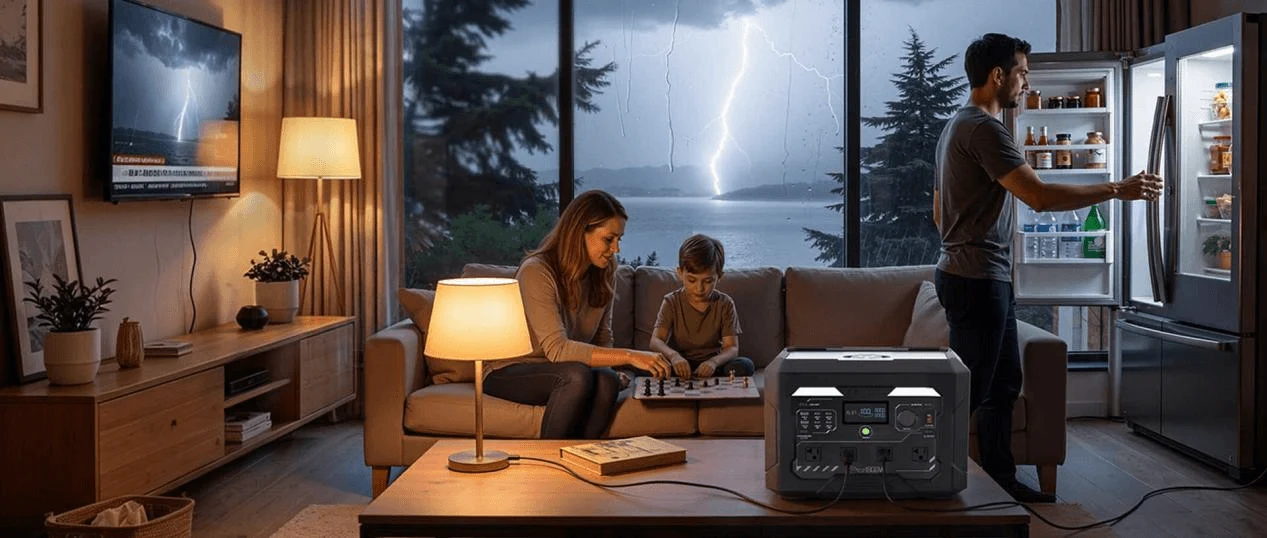

A refrigerator is often one of the highest-priority appliances during a power outage. Keeping it operating can help protect perishable food and maintain a more comfortable household routine until utility power is restored.
This GEYOTO fridge backup guide explains how to evaluate backup power for a refrigerator, including running wattage, compressor startup demand, battery capacity, output ratings, recharge speed, and other practical considerations.
Start With Your Refrigerator’s Power Requirements
Before choosing a portable power station, find the refrigerator’s electrical specifications. The manufacturer’s label, owner’s manual, or product documentation may provide the information you need.
Pay attention to:
- Running or rated wattage
- Voltage requirements
- Startup or surge wattage
- Any specific electrical requirements
Refrigerators vary by model, size, efficiency, and compressor design, so actual power requirements should be checked rather than estimated from a generic figure.
Understand Compressor Startup Power
A refrigerator compressor cycles on and off. Although its normal operating power may be relatively modest, the compressor can temporarily draw more electricity when starting.
This temporary demand is commonly referred to as startup, surge, or peak power.
For reliable backup, the portable power station should have enough continuous output to operate the refrigerator normally and enough peak output to accommodate its startup requirement.
Continuous Output vs. Peak Output
Continuous and peak ratings serve different purposes.
Continuous output is the amount of power the system can provide during regular operation.
Peak output is the higher level of power the system can provide temporarily.
The GEYOTO N300 provides 300W continuous pure sine wave output and 500W peak output.
The GEYOTO N1000 provides 1,800W continuous pure sine wave output and 3,000W peak output.
Compare these ratings with the refrigerator’s documented running and startup requirements before connecting the appliance.
Consider Battery Capacity
Output is only one part of refrigerator backup planning. If you are using a battery-powered portable power station, you should also consider battery capacity.
Capacity is measured in watt-hours (Wh). It indicates how much energy the battery stores.
The GEYOTO N300 has a 256Wh capacity, while the N1000 has a 1,024Wh capacity.
Higher capacity generally means more stored energy, but it does not automatically translate into a specific refrigerator runtime. Actual runtime depends on the refrigerator’s consumption, compressor cycling, conversion efficiency, environmental conditions, and other connected loads.
GEYOTO N300: Compact Backup Power
The N300 is positioned as a “Grab and Go” portable power station for compact backup and outdoor applications.
Its approved specifications include:
- Capacity: 256Wh
- Rated output: 300W continuous pure sine wave
- Peak output: 500W
- Constant Power: 550W
- Battery: LiFePO4
- Battery life: 4,000 cycles
- Full recharge: About 1.5 hours
- Output outlets: 9
- Wireless charging: 25W
- UPS switching: Less than 10ms
The N300 is intended for camping, travel, small electronics, Wi-Fi routers, laptops, lighting, and short-term outage backup.
A particular refrigerator should only be connected after confirming that its electrical requirements fall within the N300’s supported operating limits.
GEYOTO N1000: Higher-Capacity Home Backup
The N1000 is positioned as an “All-in-One: One Station. Fully Loaded.” portable power solution for higher-capacity needs.
Its approved specifications include:
- Capacity: 1,024Wh
- Rated output: 1,800W continuous pure sine wave
- Peak output: 3,000W
- Constant Power: 2,400W
- Battery: LiFePO4
- Battery life: 4,000 cycles
- 0–80% recharge: 43 minutes
- 100% recharge: 68 minutes
- Total ports and interfaces: 18
- Output ports: 13
- Wireless charging: Qi2.2 25W
- UPS switching: Less than 10ms
- Vehicle-support output: XT60, 12.6V/30A, up to 378W
The N1000 is designed for home emergencies and can support compatible refrigerators, CPAP machines, fans, Wi-Fi equipment, RV trips, camping, and vehicle-support scenarios.
Estimate How Long the Battery May Last
A basic theoretical formula for battery runtime is:
Runtime = Battery capacity (Wh) ÷ Load (W)
For refrigerators, this should only be treated as a rough estimate. The compressor cycles instead of running continuously, and factors such as temperature, door openings, appliance efficiency, and inverter losses can change actual energy consumption.
Other equipment connected to the same power station will also reduce available runtime.
Understand Constant Power Mode
The N300 provides a 550W Constant Power mode, while the N1000 provides a 2,400W Constant Power mode.
Constant Power mode can provide additional flexibility for compatible equipment under specified operating conditions. It does not increase the amount of energy stored in the battery.
Higher-power operation can consume stored energy more quickly, so users should consider both the load and available battery capacity.
Pure Sine Wave Output
Both the N300 and N1000 provide pure sine wave output.
This type of AC output is designed to provide a waveform similar to utility electricity and can be an important consideration for appliances with motors and compressors.
However, pure sine wave output does not by itself guarantee compatibility. Always check the refrigerator manufacturer’s electrical requirements before connecting it to a portable power station.
Consider Other Appliances
During an outage, you may want the same backup system to operate more than the refrigerator.
Common essential devices might include:
- Wi-Fi router and modem
- Essential lighting
- Phone chargers
- Laptop
- Fan
- Other compatible low-power electronics
Add the expected running loads together and compare the total with the generator’s continuous output.
Also consider startup demands from any equipment containing motors or compressors. If the refrigerator is the highest priority, limiting nonessential loads can help preserve battery energy.
Recharge Speed Can Matter
The ability to recharge quickly can be useful when outages happen repeatedly or when utility service returns temporarily.
The N300 can fully recharge in about 1.5 hours.
The N1000 can reach 0–80% in 43 minutes and 100% in 68 minutes.
Faster charging can help restore the backup system’s available energy sooner after use.
UPS Switching Capability
The N300 and N1000 both have a specified UPS switching time of less than 10 milliseconds.
UPS functionality can help reduce interruptions for compatible connected electronics when utility power fails. Verify the requirements of individual devices before relying on UPS operation.
Practical Tips for Refrigerator Backup
Once you have confirmed that your backup power station is compatible, energy management can help extend available runtime.
Keep the refrigerator and freezer doors closed as much as possible during an outage. Unnecessary opening allows cold air to escape and can increase cooling demand.
If battery capacity becomes limited, disconnect optional devices and prioritize refrigeration and other essential equipment.
Prepare Before an Outage
Do not wait for the power to fail before checking your backup equipment.
Before an outage:
- Keep the power station charged according to the manufacturer’s recommendations.
- Identify the refrigerator’s running and startup requirements.
- Keep necessary cables and adapters accessible.
- Check the generator’s output limits.
- Decide which appliances have priority.
- Follow the manufacturer’s operating and storage instructions.
Preparation can make it easier to manage the available power during an unexpected outage.
Final Thoughts
Choosing refrigerator backup power requires looking at both immediate power delivery and stored energy. The system must have enough continuous output for normal refrigerator operation, sufficient peak output for compressor startup, and enough battery capacity for the expected outage duration.
The GEYOTO N300 offers 256Wh, 300W continuous output, and 500W peak output for compact and short-term backup applications. The N1000 provides 1,024Wh, 1,800W continuous output, and 3,000W peak output and is positioned for higher-capacity home emergency applications that include compatible refrigerators.
The best approach is to check your refrigerator’s actual electrical specifications first and then compare them with the portable power station’s output, capacity, recharge speed, and operating features.