
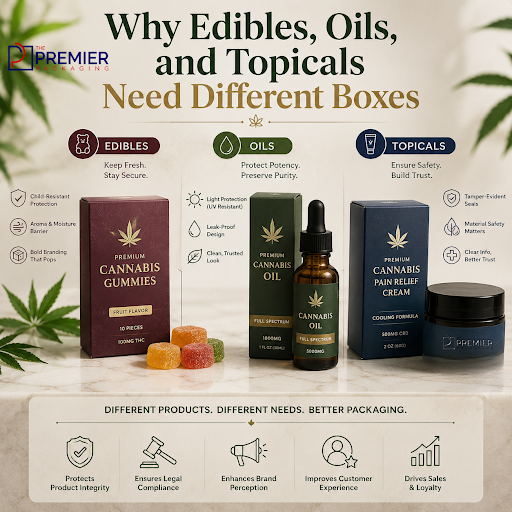

Three types of products, three entirely distinct packaging challenges to be addressed. This is a glass bottle featuring a thin dropper on the cap. An edible is any substance that is soft and fragile in its environment. Topical: thick tub or tube. All three are packaged in the same manner, and at least two will let you down. Here are the contents each format expects to find in a box.
Oils: Glass and Droppers Set the Rules
Oil bottles are the weakest of the three, and their ‘weakness’ isn’t the bottle. It’s a dropper assembly at the top.
A dropper provides height, uses a thin glass pipette, and relies on a seal that can fail under pressure. The box should be measured to full height (dropper included) and there should be no clearance where it presses down on the cap when stacking.
Oil packaging needs to provide:
- Full height (with dropper).
- Free above the cap.
- The upright position to prevent damage to the seal.
The common error is to dimension the box based solely on the bottle. It fits the bottle like a dream, but it ruins the dropper all the same.
Edibles: It’s Time to Protect the Environment
Edibles alter the problem altogether. It’s not so much the glass as the contents.
Chocolate melts when the temperature rises. Gummies clump together and get formless. Baked food becomes dry. The packaging must protect against temperature and moisture, not just impact, and often includes an inner barrier layer within the printed outer box.
Generally, there are requirements for the edible packaging, such as:
- An internal barrier in the carton.
- Heat and moisture resistance.
- A building that is able to withstand collapse.
The outer box is for branding and structure. The inner layer is responsible for protection. Almost all CBD packaging for edibles requires both.
Topicals: Weight Is the Constraint
Topicals are tubs, jars or tubes of creams, balms and salves. They’re much heavier than the other two formats, and that’s everything to everything!
Balm is dense in a glass jar. Several in shipping cartons make up the real load on board, so the board must be specified to be for weight and not box size. The tubes pose another problem because they may be squeezed or burst if the box is movable.
Topical packaging should be able to withstand:
- It is recommended to use the board specified for real weight instead.
- Crushing resistance when stacking.
- Assist in keeping tubes from bending.
With jar candles, with any dense product, weight is the key element here.
Rather, the Insert Diverges Completely.
When the failure modes are different, so are the interiors. The three formats get very different when they’re in the box.
The oil bottle should be held in a cradle so that the bottom is supported, but the dropper is not. A rigid cavity is not necessary; an edible requires a tray or barrier pouch instead. To prevent a topical tub from sliding around on its own, it must have a firm seat. Same category, three unrelated solutions.
There are some differences in the insertion requirements:
- Oils: base cradle, cap clearance.
- Edibles: tray or barrier pouch.
- Topicals: secure seat on weight.
By designing a single insert to be reused across a whole range, brands end up with damage on one line. The best CBD packaging is one that is all unique inside.
Orientation Matters Differently
Each product has a different transit profile, and it’s important to make a conscious choice rather than a random one.
Oils should remain upright, as the liquid will pool against the bottle’s seal, increasing the risk of leaks when the bottle is flat. Edibles will typically be very thin, but as long as there is no pressure being applied, it will be fine. Topical tubs are fairly stable in all orientations, except that tubes are best supported lengthwise.
Orientation assistance by the format:
- Oils: erect as much as possible.
- Edibles: flat is OK with support.
- Topicals: stable but fully supported with tubes.
If the orientation isn’t correct, it can be a silent killer for an otherwise well-specified and carefully designed box.
A great deal of thought is needed for this type of presentation.
The three formats also sell differently, and that affects both the exterior and the interior.
Oil packaging is often premium, and because these products are premium, customers are extremely sensitive to product quality. Window boxes are often utilized in edibles to make the product visible. Topicals are more akin to cosmetic products, where simplicity of design and quality of feel are important. An all-purpose house style that works for everyone is less than satisfactory for any of them.
Presentation priorities vary:
- Oils: high-quality finish and feel.
- Edibles: visibility of product.
- Topicals: cosmetic-style presentation.
Think of each format in terms of the actual purchase of that product.
What is common to all three?
Some requirements do overlap, and if you can pull out the differences between them, it will be much easier to specify.
These three all have a tight fit; if the interior is loose, it is damaged in each case. All three are good for a stiff board, which will retain its shape during handling. All three should have planned space for the information you need, depending on the market and where you sell.
Shared requirements include:
- No movement within the box.
- A board that is firm and has good shape.
- Designed space for compulsory text.
The common needs are simple packing discipline. The differences are in the engineering that’s format-specific.
Final Thoughts
There are three different ways that oils, edibles, and topicals fall, and hence three different boxes.
Oils are like glass and come with a thin dropper. Measure the entire height of the bottle, including the cap, leave space above, and keep the bottles upright. Since edibles are heat– and moisture-sensitive, they generally require an inner barrier layer to serve protective functions within the carton. Topicals are heavy, so make sure to give board for the weight and stacking load, not the size of the box.
The error to be prevented is the assumption that a complete product line is a single packaging issue. Calculate how each format can go wrong, then design to prevent it. CBD packaging with a focus on the actual vulnerability of every product is not much more costly than a typical packaging, and intact it arrives much more often.