

As enterprises expand across geographies and technology footprints, the question is no longer whether to build a global capability center, but how to make it deliver real strategic value rather than becoming just a cost-arbitrage back office. One of the clearest ways a global capability center proves its worth is through application managed services — providing round-the-clock support, faster incident resolution, and consistent operational discipline across every application the enterprise depends on.
The GCC model has evolved considerably over the last decade. Early centers focused primarily on cost. Today’s most successful centers focus on capability, ownership, and long-term innovation partnership with the business, using application managed services as a proving ground for deeper strategic contributions that eventually extend across the enterprise technology portfolio.
From Cost Center to Strategic Capability
Early-generation global capability centers were built primarily to reduce cost. Today’s most successful centers are built around capability — deep technical expertise, ownership of critical systems, and the ability to operate with the same rigor as any headquarters-based team. This shift changes how the center is staffed, measured, and empowered inside the broader organization.
Application managed services is often where this transition becomes most visible. As GCCs take on full ownership of production support, freeing regional teams to focus on innovation rather than day-to-day maintenance, the value narrative shifts from savings to strategic enablement — and executive sponsorship becomes much easier to sustain over multiple budget cycles.
Follow-the-Sun Support Models
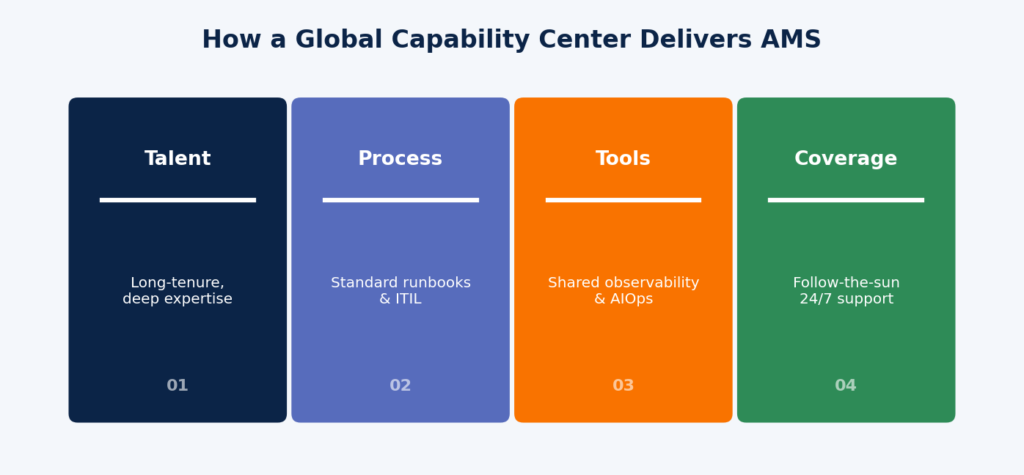
A well-structured global capability center enables true 24/7 application coverage without requiring any single team to work overnight shifts. This improves both response times and employee retention, since engineers get to work sane hours while the enterprise still enjoys around-the-clock protection for critical systems and customer-facing services.
Building Institutional Knowledge, Not Just Headcount
Mature GCCs invest in documentation, cross-training, communities of practice, and knowledge retention practices so critical application expertise does not walk out the door with any single employee. This is what turns a group of engineers into a genuine capability the enterprise can rely on for years, not just quarters.
Standardizing Application Support at Scale
As enterprises grow their application portfolios, inconsistent support practices across regions become a real liability. A global capability center centralizes application managed services under one operating model — shared runbooks, unified ticketing, consistent SLAs, and a single escalation ladder regardless of which region raised the issue.
This consistency does not just improve uptime. It also makes it far easier to identify recurring issues across the application portfolio and address root causes rather than symptoms. Patterns that would stay invisible in a fragmented support model become obvious when one team sees the full picture, which in turn drives smarter architectural decisions across the enterprise.
- Centralized ticketing and escalation paths across every supported application
- Standardized runbooks so any team member can respond confidently to common incidents
- Shared knowledge base reducing resolution time for recurring issues
- Regular retrospectives feeding recurring problems back into application modernization roadmaps
- Consistent onboarding paths so new engineers reach productivity quickly
- AIOps and observability platforms shared across all supported systems
The Talent Advantage of a Well-Run GCC
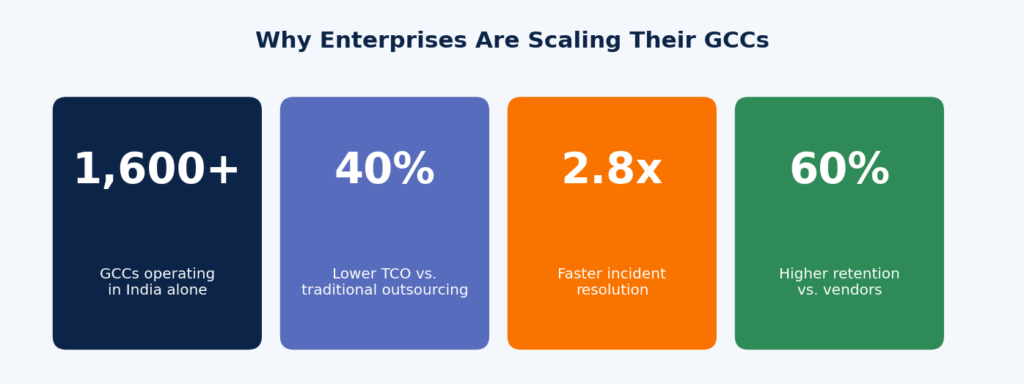
Talent is the single biggest reason global capability centers succeed or struggle. India, in particular, has become the epicenter of the modern GCC movement, home to thousands of such centers operating across sectors from banking and retail to healthcare and manufacturing. The talent depth in these hubs — engineers with cloud, DevOps, data, and product skills — makes it possible for a well-run GCC to compete with any headquarters team on quality of work.
The best GCCs invest heavily in ongoing learning: certifications, hackathons, rotational programs, and dedicated engineering upskilling. This turns the GCC into an attractive employer rather than a captive back office, which in turn reduces attrition and deepens institutional knowledge. Enterprises that get this right find their application managed services teams becoming the most experienced part of the entire technology organization within a few years.
The Long-Term Payoff of Getting GCC Strategy Right
Enterprises that invest deliberately in their global capability center’s talent, processes, and technology find that application managed services delivered from the GCC often outperform traditional outsourced or in-house models on both cost and quality. This creates a virtuous cycle: better outcomes attract better executive sponsorship, which attracts stronger talent, which delivers even better outcomes.
The result is a support function that scales with the business rather than becoming a bottleneck as application portfolios grow more complex. Increasingly, forward-looking GCCs are also acting as centers of excellence for emerging practices — cloud engineering, AI operations, and platform engineering — meaning application managed services is often just the beginning of the strategic value the center delivers over time.
Best Practices for a High-Performing Global Capability Center
The GCCs that consistently outperform share a set of practical disciplines that keep the center strategic rather than just cost-focused over multiple planning cycles.
- Publish clear career ladders so engineers see long-term growth inside the global capability center
- Rotate GCC engineers into product teams periodically to keep application managed services grounded in real user needs
- Invest in communities of practice — guilds, internal talks, hackathons — that keep learning alive
- Measure GCC value by product-team velocity and platform reliability, not just ticket volume or cost per FTE
Actionable Insights for Enterprise Leaders
- Design follow-the-sun coverage models early to avoid burnout and inconsistent response times across regions
- Invest in documentation and knowledge management so expertise is not concentrated in a few individuals who could leave
- Standardize runbooks, tooling, and SLAs across every application supported by the global capability center
- Feed recurring incident patterns back into the application modernization roadmap to drive lasting improvements
- Position application managed services as the starting point, not the end point, of what the GCC can deliver
- Measure and communicate strategic contributions from the GCC, not just cost savings, to keep executive sponsorship strong
Conclusion
A global capability center reaches its full potential when it moves beyond cost savings and becomes a genuine center of application managed services excellence. Enterprises that invest in the right talent, processes, and standardization within their GCC consistently achieve more reliable, more scalable application support — turning what was once a back-office function into a strategic advantage that helps the business move faster, more safely, and with more confidence in its technology backbone.