
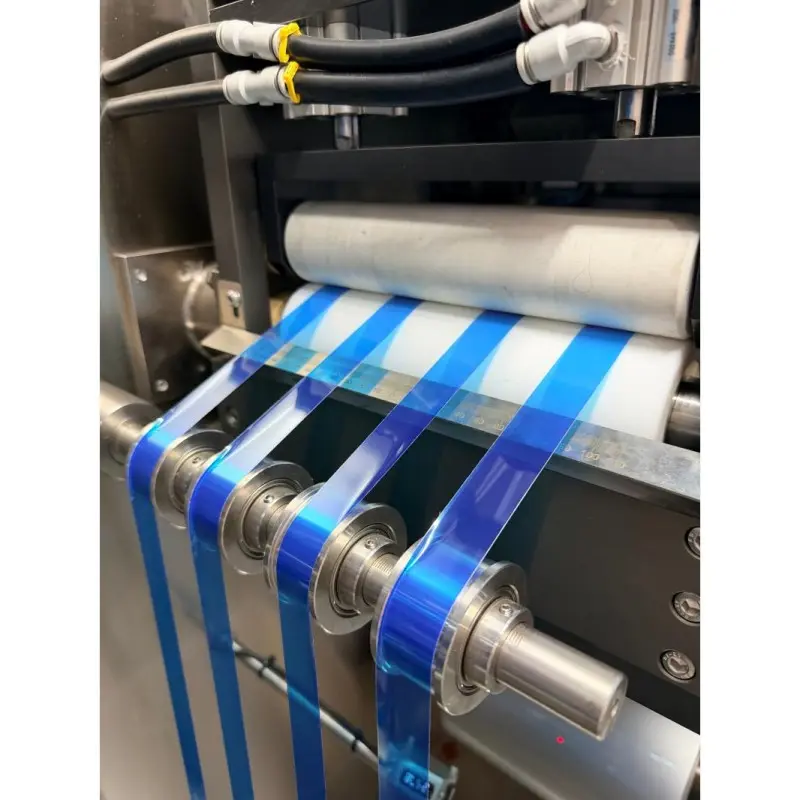

Efficient pouch production depends on accurate film handling, controlled filling, reliable sealing, and consistent machine operation. When these stages are properly coordinated, manufacturers can produce water-soluble pouches with fewer interruptions and more predictable quality.
A well-designed Water Soluble Film Equipment system brings several packaging operations together within a controlled workflow. POLYVA solutions can support film feeding, pouch forming, dosing, sealing, and cutting, helping production teams maintain a steady process from raw film to finished pouches.
From Film Roll to Finished Pouch
The production process begins with the water-soluble film. The equipment guides the material through a sequence of controlled operations that transform a continuous film into individual packages.
Each stage affects the next one. Stable film feeding supports accurate forming, while accurate forming creates the conditions needed for consistent filling and sealing.
Controlled Film Handling
Film handling is an important part of efficient pouch production. Water-soluble film needs to move through the equipment without unnecessary stretching, slipping, or misalignment.
Film guides, rollers, tension controls, and feeding mechanisms work together to maintain proper positioning. Stable film movement can reduce wrinkles and dimensional variations that might otherwise result in rejected pouches.
Accurate Pouch Formation
Once the film reaches the forming section, it is shaped according to the required pouch design. Forming dimensions need to correspond with the product quantity and packaging specifications.
Consistent forming helps ensure that each pouch has enough space for the intended dose while avoiding unnecessary film consumption. Proper machine adjustment is particularly important when pouch dimensions change.
Efficient Product Filling
Filling is another key factor in pouch production efficiency. Automated dosing systems can deliver measured quantities of product into formed film pockets.
The filling method should be selected according to the product’s characteristics. Powders, liquids, granules, and other formulations can behave differently, so dosing equipment and operating parameters need to be appropriately configured.
Keeping Filling and Forming Synchronized
Efficient production requires the forming and filling stages to work together. The product must enter the pouch at the correct position and at the appropriate point in the production cycle.
Machine controls and sensors can help coordinate these operations. Good synchronization reduces empty pouches, misplaced product, and unnecessary production stops.
Reliable Sealing
Sealing closes the filled pouch and protects its contents. For efficient production, the sealing system needs to create reliable seams without requiring frequent adjustments.
Sealing conditions should be matched to the water-soluble film. Factors such as temperature, pressure, contact time, film alignment, and machine speed can influence the final result.
Minimizing Film Waste
Efficient pouch production is closely connected to material utilization. Excess film can be consumed when pouch dimensions are unnecessarily large, film feeding is unstable, or defective packages require replacement.
Optimizing forming dimensions and maintaining controlled film movement can help reduce avoidable waste. Consistent sealing also prevents finished pouches from being rejected because of package integrity problems.
Automated Cutting and Separation
After sealing, the continuous package structure must be divided into individual pouches. Automated cutting systems coordinate separation with pouch dimensions and production timing.
Accurate cutting helps maintain uniform package sizes and reduces damage around pouch edges. It also allows finished pouches to move efficiently to the next stage of production.
Reducing Manual Handling
Automation can reduce the amount of repetitive manual work required during pouch production. Instead of manually forming and filling each package, operators can supervise a coordinated production system.
This allows personnel to focus on machine monitoring, quality checks, material changes, and routine maintenance.
Production Speed and Stability
Higher speed does not automatically mean greater efficiency. If film feeding, filling, or sealing becomes unstable at a particular speed, the resulting defects and stoppages can offset the additional output.
The most practical operating speed is generally one that maintains stable pouch quality while providing the required production capacity.
Supporting Consistent Quality
Efficient production should also produce consistent results. Quality checks can focus on factors such as:
- Pouch dimensions
- Fill weight
- Film alignment
- Seal appearance
- Seal integrity
- Cutting accuracy
Monitoring these characteristics during production helps identify problems before they affect a large number of packages.
The Importance of Film Compatibility
Different water-soluble films can have different thicknesses and mechanical or sealing properties. Equipment should therefore be evaluated against the specific film intended for production.
When switching between film specifications, operators may need to adjust feeding, forming, or sealing parameters. Controlled testing helps establish suitable settings before full production begins.
Maintenance for Efficient Operation
Machine efficiency depends partly on equipment condition. Worn rollers, dirty sealing surfaces, damaged guides, or poorly maintained dosing components can contribute to inconsistent production.
A preventive maintenance program helps identify wear before it causes significant downtime. Regular cleaning and inspection can also support more stable machine performance.
Environmental Control
Water-soluble film can be affected by environmental moisture. Unsuitable storage or production conditions may influence film handling and packaging behavior.
Keeping film protected during storage and maintaining appropriate production conditions can help reduce material-related problems and support more predictable pouch formation.
Improving the Production Workflow
Manufacturers can improve pouch production efficiency by combining several practices:
- Select film compatible with the equipment.
- Establish appropriate forming and filling parameters.
- Maintain stable film tension and alignment.
- Monitor sealing conditions.
- Track reject rates and material consumption.
- Perform preventive maintenance.
- Standardize setup and changeover procedures.
These practices help create a more controlled production environment.
Conclusion
Water-soluble pouch production becomes more efficient when film handling, forming, filling, sealing, and cutting operate as one coordinated process. Properly configured equipment can reduce manual intervention, control material usage, and maintain consistent production conditions.
By selecting compatible film, optimizing machine parameters, monitoring quality, and maintaining the equipment regularly, manufacturers can build a reliable pouch production workflow that supports both efficiency and consistent package quality.