

In modern metal processing industries, plant design plays a decisive role in determining production efficiency, product quality, and operational safety. A well-planned layout ensures smooth material flow, reduced downtime, and optimal utilization of space and resources. This is especially important for continuous surface treatment systems used in steel and aluminum manufacturing.
A properly engineered color coating line is not just a sequence of machines but a fully integrated production system. Its design and layout must support continuous movement of metal coils through pretreatment, coating, curing, and recoiling stages while maintaining stability, precision, and energy efficiency. Careful planning at the design stage directly influences long-term operational performance.
Importance of Layout Planning in Industrial Plants
The layout of a coating facility determines how efficiently materials and energy flow through the system. Poor design can lead to bottlenecks, excessive handling, and increased operational costs.
A well-structured layout helps achieve:
- Smooth and continuous material flow
- Reduced handling time and mechanical stress on coils
- Improved safety for operators and maintenance staff
- Better coordination between production stages
- Easier maintenance and equipment access
These factors contribute to higher productivity and more stable long-term operation.
Key Sections in a Color Coating Line Layout
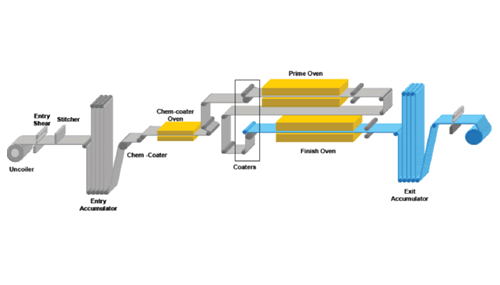
A typical coating plant layout is divided into several functional sections, each serving a specific role in the production process.
Entry Section
The entry section is responsible for coil loading, unwinding, and tension control. Proper spacing and alignment in this area ensure that coils enter the system smoothly without surface damage or misalignment.
Pretreatment Zone
This section includes cleaning, degreasing, rinsing, and chemical treatment units. It requires adequate space for chemical tanks, drainage systems, and ventilation equipment. Proper isolation is also necessary to ensure environmental safety.
Coating Area
The coating section is the core of the system and requires precise environmental control. Layout design must ensure stable temperature, dust-free conditions, and sufficient space for roller coating machines and material handling systems.
Curing Oven Zone
The curing oven is typically the longest component in the line. Its placement must allow for efficient heat management and safe exhaust ventilation. Adequate spacing is required to prevent heat interference with nearby equipment.
Cooling and Exit Section
After curing, the metal must be cooled before recoiling. This area requires sufficient space for controlled cooling systems and recoiling machines. Proper layout ensures smooth exit flow and prevents damage to finished products.
Factors Influencing Plant Design
Several technical and operational factors must be considered when designing a coating plant layout.
1. Production Capacity Requirements
Higher capacity systems require longer line configurations and larger equipment spacing to maintain stable operation.
2. Material Flow Direction
A linear and uninterrupted flow reduces handling complexity and improves efficiency.
3. Space Availability
Plant size directly influences equipment arrangement, safety clearance, and maintenance access.
4. Energy Efficiency
Proper layout reduces heat loss and improves energy utilization, especially in curing oven systems.
5. Safety and Environmental Control
Ventilation systems, chemical storage areas, and emergency access routes must be integrated into the layout design.
Automation and Integration in Modern Layouts
Modern industrial plants rely heavily on automation to optimize performance. Control systems are integrated into the layout to monitor and manage production parameters in real time.
Key automation features include:
- Centralized control of line speed and tension
- Real-time monitoring of coating thickness
- Temperature regulation in curing ovens
- Automated fault detection systems
These technologies help ensure consistent product quality and reduce manual intervention.
Space Optimization and Maintenance Accessibility
Efficient plant design also focuses on maximizing usable space while ensuring easy access for maintenance. Equipment must be arranged in a way that allows technicians to perform inspections, repairs, and replacements without disrupting production.
Proper spacing between units reduces downtime and improves operational safety. Maintenance-friendly design also extends equipment lifespan and reduces long-term costs.
Conclusion
The design and layout of industrial coating facilities play a crucial role in determining overall production efficiency and product quality. Every section, from coil entry to final recoiling, must be carefully planned to ensure smooth material flow, safety, and energy efficiency. A well-designed color coating line not only enhances operational performance but also supports long-term scalability and reliability, making it a vital component of modern metal processing plants.