
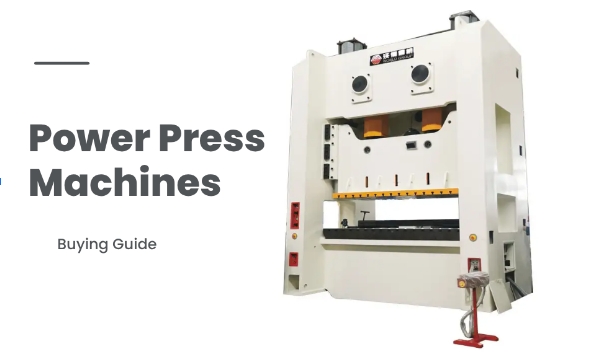

Power press technology has become a fundamental part of modern manufacturing, enabling industries to produce metal components with speed, precision, and efficiency. From automotive and aerospace to electronics and appliance production, power presses play a critical role in shaping, cutting, and forming metal materials. Their evolution over the years has transformed manufacturing processes, making them more automated, reliable, and cost-effective.
The basic principle of a power press involves applying controlled force through a punch and die system to shape, cut, or form metal sheets. By converting mechanical, hydraulic, or pneumatic energy into linear motion, the machine delivers repeated strokes with consistent precision. This capability allows manufacturers to produce large quantities of parts that meet tight tolerances and high-quality standards.
A Power Press is at the center of this technological advancement. Modern machines incorporate advanced features such as servo drives, digital controls, and automated feeding systems. These enhancements improve productivity, reduce labor requirements, and allow for greater customization in production. The integration of technology into power presses ensures that they remain indispensable in contemporary manufacturing environments.
Evolution of Power Press Technology
Power press technology has evolved significantly since the early mechanical presses were introduced. Initially, machines relied solely on flywheel and crank mechanisms to convert rotational motion into pressing force. While effective, these mechanical presses were limited in terms of precision and flexibility.
Hydraulic presses later addressed these limitations by offering adjustable force control and the ability to maintain pressure throughout the stroke. Pneumatic presses, on the other hand, allowed for lighter-duty operations with faster cycle times and easier automation. The latest development, servo-driven presses, combines precision, speed, and programmability, enabling manufacturers to perform complex operations with minimal manual intervention.
Key Components and Functionality
Modern power presses consist of several key components, including the frame, ram, punch, die, and control system. The frame provides the structural stability required to withstand high forces during operation. The ram, driven by mechanical, hydraulic, or servo systems, applies pressure to the workpiece. The punch and die define the shape and size of the final product, while the control system regulates speed, force, and stroke for optimal results.
Advanced presses also include automated feeding systems, sensors, and safety mechanisms. These features allow for continuous operation with minimal human intervention, improving efficiency while ensuring operator safety. By integrating these components, manufacturers can achieve high precision and consistent output across production runs.
Applications in Modern Manufacturing
Power press technology is versatile and used across numerous industries. In the automotive sector, presses are essential for producing body panels, engine components, and structural parts. The ability to perform high-speed stamping and forming ensures that manufacturers can meet large-scale production demands efficiently.
In electronics and appliances, presses are used to manufacture enclosures, connectors, and metal frames. These applications require precision and repeatability, which modern power presses provide. The construction industry also relies on these machines to produce brackets, panels, and other structural components with high strength and accuracy.
Advantages of Power Press Technology
One of the main advantages of power press technology is its ability to combine speed and precision. Modern presses can complete hundreds or even thousands of strokes per hour, producing uniform parts with minimal errors. This consistency reduces material waste and ensures that components meet stringent quality standards.
The flexibility of power presses is another benefit. They can handle a wide range of metals and perform various operations, including blanking, punching, bending, forming, and deep drawing. This versatility reduces the need for multiple specialized machines and allows manufacturers to adapt quickly to changing production requirements.
Automation integration further enhances efficiency. Robotic feeding systems, CNC controls, and sensors allow for continuous operation and data monitoring, which helps optimize production schedules and predict maintenance needs. Additionally, advanced safety features protect operators while maintaining productivity, making power presses suitable for modern manufacturing facilities.
Future Trends in Power Press Technology
As manufacturing continues to evolve, power press technology is expected to incorporate even more advanced features. Artificial intelligence and machine learning may be integrated for predictive maintenance and process optimization. Improved servo and digital control systems will allow for greater customization and precision in component production.
Sustainability is also becoming a priority. Energy-efficient presses and optimized production processes can reduce environmental impact while maintaining high output. These trends will ensure that power press technology remains central to manufacturing in the coming decades.
Conclusion
Power press technology plays a crucial role in modern manufacturing by combining speed, precision, and flexibility. Its evolution from mechanical to hydraulic and servo-driven systems has enabled industries to meet increasing production demands while maintaining high-quality standards. With advanced automation, safety features, and integration possibilities, power presses continue to transform industrial processes, making them an indispensable tool in contemporary manufacturing environments.