
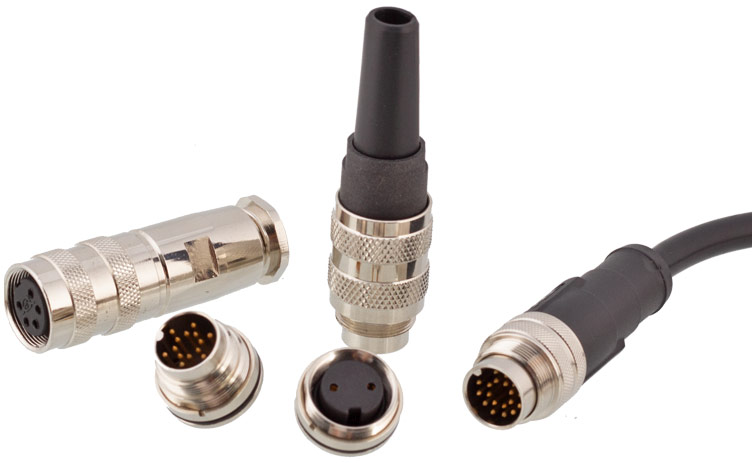

In industrial automation and control systems, choosing the right connector is critical for ensuring reliable electrical performance, mechanical stability, and long-term durability. Two of the most widely used circular connectors are the M16 and M12 connectors. While both share a similar design philosophy, their size, electrical capacity, and application suitability differ significantly. Understanding these differences is essential for engineers and designers when selecting the appropriate connector for specific industrial or automation needs.
The M16 Connector and M12 connector are both standardized, threaded circular connectors commonly used to connect sensors, actuators, and other field devices. They offer secure coupling, vibration resistance, and environmental protection, but their distinct dimensions and electrical characteristics make them suitable for different applications. A technical comparison helps highlight their respective advantages and limitations.
Size and Mechanical Design
The most obvious difference between M16 and M12 connectors is their size. As the name suggests, M16 connectors feature a 16 mm threaded coupling, whereas M12 connectors have a 12 mm thread. This size difference has a direct impact on mechanical stability, contact spacing, and overall robustness.
M16 connectors, being larger, provide more room for contacts and insulation. This makes them suitable for applications requiring higher pin counts, increased current capacity, or improved environmental sealing. The larger housing also allows for easier handling and more secure mechanical coupling, especially in heavy-duty machinery or vibration-prone environments.
M12 connectors, by contrast, are smaller and lighter, making them ideal for compact devices or applications where space is limited. While mechanically robust, M12 connectors are better suited for low to medium current applications and lower pin counts.
Electrical Performance
Electrical characteristics are a key differentiator between M16 and M12 connectors. M16 connectors are generally capable of handling higher voltage and current levels due to their larger contact size and greater spacing. Typical M16 connector ratings range from 250 V to 400 V and 4 A to 10 A per contact, depending on the pin configuration and manufacturer. This makes them suitable for power transmission as well as signal and data applications.
M12 connectors usually operate at lower voltage and current levels, often in the range of 60 V to 250 V and 2 A to 4 A per contact. They are primarily used for signal transmission, sensor connections, and low-power devices. The smaller contact area limits current carrying capacity, which should be considered when designing industrial systems.
Pin Configurations and Coding
Both M16 and M12 connectors support multiple pin configurations and coding types, which prevent mismating and allow for application-specific connections. M16 connectors can accommodate higher pin counts, typically ranging from 3 to 12 pins, making them suitable for complex devices that require multiple signal lines or a combination of power and data.
M12 connectors generally range from 3 to 8 pins. Common coding types include A-coded for sensors and actuators, D-coded for Ethernet communication, and B-coded for fieldbus systems. While M12 connectors are highly versatile, their smaller size limits maximum pin count and contact spacing compared to M16 connectors.
Environmental Protection
Both M16 and M12 connectors are designed to provide environmental protection in industrial settings. They are commonly rated for IP65, IP67, or IP68 protection when properly mated, ensuring resistance to dust, water, and other contaminants. The larger M16 connector can accommodate more robust seals and gaskets, offering slightly better protection in extreme conditions or outdoor applications.
M12 connectors, while smaller, still provide excellent sealing and are suitable for indoor and semi-outdoor environments, as well as for applications with less severe exposure to harsh conditions.
Mechanical Durability
Mechanical durability is another important consideration. M16 connectors, with their larger threaded coupling, are better suited for high-vibration or heavy-duty applications. The larger thread provides stronger mechanical stability and reduces the risk of accidental disconnection. They are also capable of withstanding more repeated mating cycles, typically up to 1000 cycles, depending on the manufacturer.
M12 connectors, being smaller, are easier to handle and install in tight spaces but may have slightly lower mechanical endurance in high-stress environments. For compact devices or applications with minimal mechanical stress, M12 connectors are generally sufficient.
Application Suitability
The choice between M16 and M12 connectors depends heavily on the specific application requirements. M16 connectors are preferred for applications requiring higher current, multiple signals, or robust environmental protection, such as industrial machinery, motor drives, and outdoor equipment. They are ideal when durability and performance outweigh size considerations.
M12 connectors excel in space-constrained installations, lightweight equipment, or low-power sensor connections. They are widely used in factory automation, robotics, and compact control systems where size and ease of installation are critical.
Conclusion
M16 and M12 connectors each have unique advantages that make them suitable for different industrial applications. M16 connectors provide higher electrical capacity, greater mechanical stability, and better environmental resilience, making them ideal for heavy-duty or high-demand systems. M12 connectors offer compact size, lightweight design, and sufficient performance for smaller devices or low-power applications. Understanding the technical differences between these connectors allows engineers to select the optimal solution for reliable, long-term performance in industrial and automation environments.