
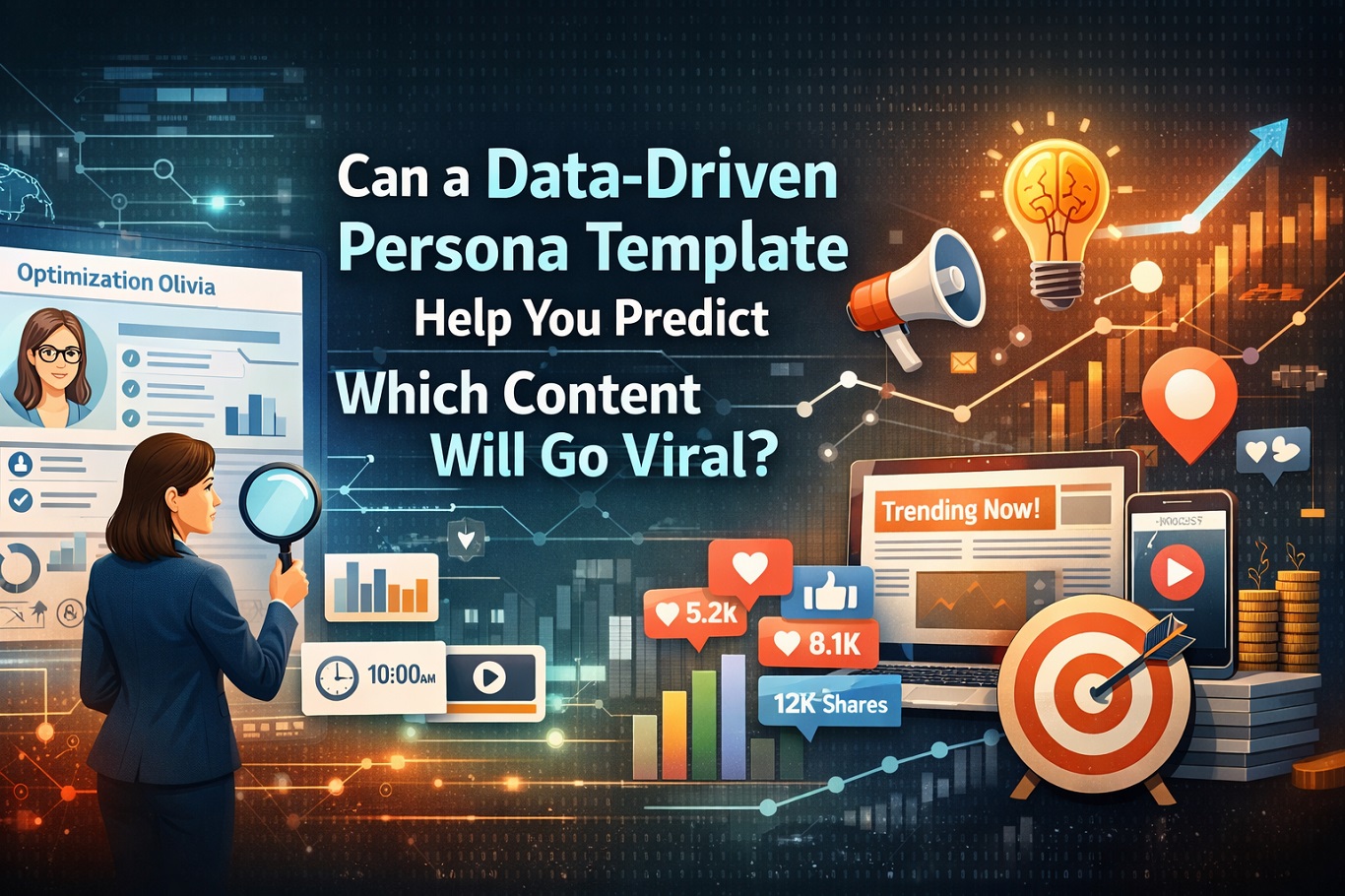

Marketing departments are more frequently reaching into the field of science than possible serendipity in today’s age and era of going viral and capturing lightning in a bottle. With the help of a Data-Driven Persona Template, companies can get beyond conventional demographics and exploit the precise behaviorsal stimulants, which spark mass sharing.
What Makes a Persona “Data-Driven” Rather Than Intuition-Based?
The data-driven persona does not rely on creative guesswork but on verifiable facts, which include website analytics, social listening, and CRM data.
Although classic archetypes may define who “Marketing Mary” could be, a data-driven template would define who “Optimization Olivia” looks like. The remarkable 2 planner can help in structuring these archetypes.
The buying behavior demonstrates that she reads and shares content at the exact time on Tuesdays at 10:00 AM, she consumes the most 15-second vids of the quick-tip ones. This degree of accuracy enables teams to model content that is congruent with real-life habits.
How Does This Template Help Identify Emerging Trends?
Viral content usually comes as a consequence of the right time. A data-driven persona template is a cutting-edge instance that incorporates social listening and real-time information to monitor what your particular audience groups are discussing directly.
Overlaying these interest spikes on your own history of preferences will allow your team to anticipate those trends that will actually capture your interest and those that are noise.
Can Behavioral Data Predict the “Shareability” of Content?
Yes. The basis of virality is psychology, and this means emotional appeals such as awe, anger, or amusement. A machine learning template provides a record of what emotional appeals have previously dominated the greatest share-to-view rates among your target audience.
In case your persona trends reveal that they post how-to instructions more frequently than opinion articles, then your marketing department can focus on creating the type of content with the greatest mathematical chance of distribution.
Does it Help in Selecting the Right Distribution Channels?
The success of viruses depends on the platform. A data-driven to-do list template not only defines the audience, but also defines where they serve as an agent of sharing. It could be that, though your viewers are on Instagram, on Reddit, they are your viral reach.
This understanding will keep your market team planting material within the particular digital environments where it will have the best opportunity of being discovered by both the influencers and algorithms.
How Do Data-Driven Personas Reduce Creative Waste?
The greatest consumption of a marketing budget is the creation of quality content that will not take off. The creative choices of the sentiment of the headline and color of the thumbnail are supported by performance metrics with a data-driven template.
This enables teams to fail quickly on paper and only devote some resources to production in a concept that meets the behaviors proven across the audience.
How Can Data-Driven Personas Improve Content Ideation at Scale?
One of the lesser-discussed advantages of a data-driven persona template is its ability to systematize content ideation. Instead of brainstorming topics in isolation or relying on subjective opinions, marketing teams can generate ideas based on repeatable data patterns. When personas are built using behavioral data, every content idea is anchored in evidence rather than assumption.
For example, if analytics reveal that a specific persona consistently engages with carousel-style posts that break down complex ideas into simple steps, this insight can guide the format of future content. Over time, this reduces creative guesswork and ensures that ideation sessions are grounded in performance-backed insights rather than intuition alone.
What Role Does Historical Performance Data Play?
Historical performance data is a cornerstone of any effective data-driven persona template. By examining which content pieces performed well in the past—and why—teams can uncover recurring signals of virality. These signals might include headline structures, content length, publishing times, or even tone of voice.
When this information is layered into a persona, it allows marketers to replicate success without copying content outright. Instead, they can reuse winning frameworks while adapting the message to new trends or platforms. This approach helps maintain originality while still benefiting from proven performance indicators.
Can Data-Driven Personas Adapt to Changing Audience Behavior?
One of the strongest arguments in favor of data-driven personas is their adaptability. Unlike static personas created once and rarely revisited, data-driven templates evolve as new data becomes available. Changes in consumer behavior—such as shifting platform preferences or emerging content formats—can be reflected in real time.
For instance, if a persona previously engaged most with blog content but now shows higher engagement with short-form video, the template can be updated accordingly. This ensures that marketing strategies remain aligned with actual audience behavior rather than outdated assumptions.
How Do They Support Cross-Functional Marketing Teams?
Data-driven personas are not limited to content marketers alone. They serve as a shared reference point for multiple teams, including SEO specialists, social media managers, paid advertising teams, and even product marketers. When everyone works from the same persona framework, consistency improves across all touchpoints.
This alignment is especially important when attempting to create viral content, as virality often depends on coordinated distribution and messaging. A unified persona ensures that the tone, timing, and platform strategy remain consistent, increasing the likelihood of widespread engagement.
Do Data-Driven Personas Help Measure ROI More Accurately?
Another critical benefit is improved measurement of return on investment. Since data-driven personas are built on measurable behaviors, it becomes easier to link content performance back to persona-specific actions. Marketers can evaluate which personas are driving the most shares, traffic, or conversions and adjust resource allocation accordingly.
This clarity allows decision-makers to justify marketing spend with concrete data. Instead of vague claims about “brand awareness,” teams can point to specific persona-driven outcomes, such as increased engagement rates or higher conversion probabilities tied to targeted content strategies.
How Do They Influence Content Personalization?
Personalization is a key driver of modern content success, and data-driven personas play a central role in achieving it. By understanding detailed behavioral triggers—such as preferred content length, emotional tone, or call-to-action style—marketers can tailor content experiences for different audience segments.
This level of personalization not only increases engagement but also enhances shareability. Content that feels personally relevant is far more likely to be shared, commented on, or recommended, which directly contributes to viral momentum.
What Are the Long-Term Strategic Benefits?
Over the long term, data-driven persona templates help organizations build institutional knowledge. Each campaign adds new data, refining the persona further and improving predictive accuracy. This creates a compounding effect where marketing decisions become smarter and more efficient over time.
Brands that invest in this approach are better positioned to anticipate audience needs, respond quickly to trend shifts, and maintain relevance in crowded digital spaces. Rather than chasing virality reactively, they develop the capability to engineer it systematically.
Final Thoughts
Predicting viral content is no longer about luck or instinct alone. With the rise of sophisticated analytics and behavioral tracking, marketers now have the tools to understand not just who their audience is, but how and why they engage. A Data-Driven Persona Template transforms raw data into actionable insight, enabling teams to create content that resonates deeply and spreads organically. By continuously refining these personas and aligning them with real-world behavior, brands can reduce wasted effort, improve creative precision, and dramatically increase their chances of producing content that captures attention at scale. In an environment where attention is the most valuable currency, being data-informed is no longer optional—it is essential.